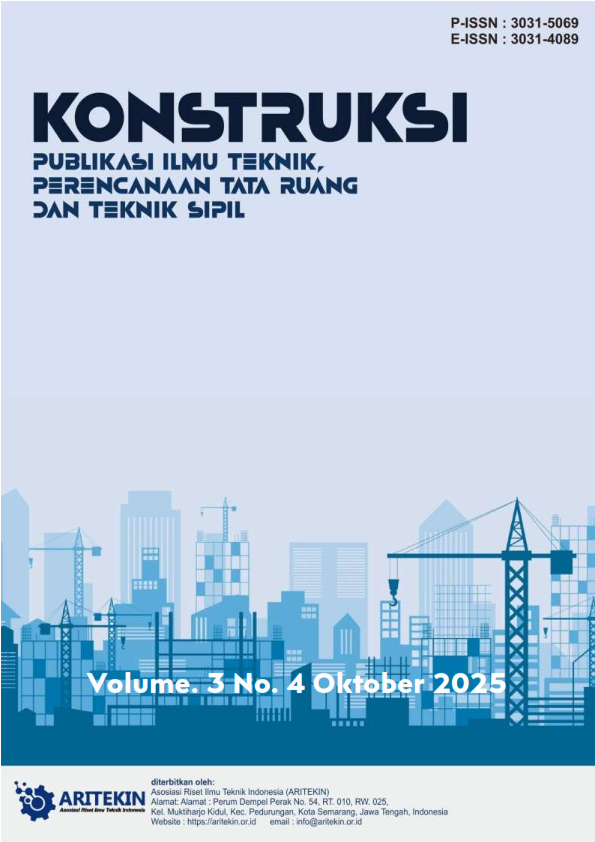
Perencanaan Gedung Perkuliahan Lantai Lima Kampus Universitas Dr. Soetomo Menggunakan Stuktur Baja
(Studi Kasus : Gedung I Universitas DR. Soetomo)
DOI:
https://doi.org/10.61132/konstruksi.v3i4.1096Keywords:
Building, Earthquake, LRFD, SAP2000, SteelAbstract
The rapid advancement of science and technology requires universities to provide safe, comfortable, and representative learning facilities. One such initiative is the construction of a five-story lecture building at Dr. Soetomo University, designed with a steel structure as an alternative to reinforced concrete. Steel was chosen due to its high tensile strength, uniform material properties, lighter weight, ease of installation, and strong resistance to earthquake loads. This study aims to design a five-story lecture building with a steel structure that meets the requirements of strength, stability, and safety in accordance with applicable standards. The method applied is structural planning based on SNI 1729:2020, SNI 1727:2020, and SNI 1726:2019 using the Load and Resistance Factor Design (LRFD) approach. Structural analysis was conducted with SAP2000 version 2014 through three-dimensional modeling that considers geometry, material properties, loading, and placement. The results show that the selected steel profiles for beams, columns, and connections are capable of supporting the combination of dead loads, live loads, and seismic loads with safe performance. The maximum stress remains below the allowable limit, and the deflection values do not exceed the permitted deviation. These findings confirm that steel provides efficiency in dimensions and materials while offering practicality and earthquake resistance, and the design produced can serve as a useful reference for future multi-story building projects in earthquake-prone regions.
References
Afif. (2016). Gedung air traffic control tower Bandara Samarinda Baru. Fakultas Teknik Sipil dan Perencanaan.
Amin, D. K. (2014). Perhitungan beban aksial kritis pada kolom baja dalam sebuah struktur portal baja. Jurnal Teknik Sipil USU, 3(1).
Dan, F., Castella, B., & Sederhana, B. (1910). Artikel_Muh. Akbar Busman, 1–9.
Darmiyanti, L., Rodji, A. P., & Mumtaz, A. (2022). Perencanaan struktur atap profil baja WF. Journal of Sustainable Civil Engineering (JOSCE), 4(2), 99–121. https://doi.org/10.47080/josce.v4i02.2258
Guci, J. M., & Putri Yastari, F. (2024). Analisis penggunaan balok rafter honeycomb untuk struktur gudang tahan gempa dengan metode LRFD. Jurnal Bangunan, Konstruksi & Desain, 2(4), 243–253. https://doi.org/10.25077/jbkd.2.4.243-253.2024
Ilham, I. (2021). Analisis kinerja bangunan rangka baja dengan bresing tahan tekuk terhadap beban gempa. RekaRacana: Jurnal Teknik Sipil, 6(2), 98. https://doi.org/10.26760/rekaracana.v6i2.98
Khafis, M. (2009). Perencanaan struktur baja pada bangunan tujuh lantai sebagai hotel [Skripsi, Universitas Sebelas Maret]. Surakarta. https://www.academia.edu/download/56155799/STRUKTUR_7_LANTAI.pdf
Prasetya, N. A., Hernadi, A., & Nugroho, A. (2021). Studi komparasi perancangan balok struktural berdasarkan SNI 2847-2002, SNI 2847-2013 dan SNI 2847-2019. Borneo Engineering: Jurnal Teknik Sipil, 5(3), 294–306. https://doi.org/10.35334/be.v5i3.1874
Sahat, I., Manalu, P., & Tarigan, J. (2015). Analisis sambungan baut terhadap gaya geser dengan perhitungan manual dan program Ansys.
Setialaksana, A. P., & Herbudiman, B. (2017). Kajian ekonomis perancangan sistem sambungan struktur baja pada rangka atap dengan variasi ukuran baut, konfigurasi baut, dan mutu baut. RekaRacana: Jurnal Teknik Sipil, 3(4), 1–11. https://ejurnal.itenas.ac.id/index.php/rekaracana/article/view/1725
Syahland, S. J. (2017). Perhitungan plat lantai struktur existing pada Gedung Puskesmas Ganjar Agung Kota Metro. TAPAK (Teknologi Aplikasi Konstruksi), 6(2), 190–203.
Yusmar, F., Prita Melinda, A., Sandra, N., & Sipil, J. T. (2021). Studi komparasi perhitungan beban gempa statik ekuivalen menggunakan aplikasi metode elemen hingga dengan SNI 1726:2019. Jurnal Teknik Sipil, 10(2), 114–123. https://doi.org/10.24815/jts.v10i2.22767
Zachari, M. Y., & Turuallo, G. (2020). Analisis struktur baja tahan gempa dengan sistem SRPMK (Struktur Rangka Pemikul Momen Khusus) berdasarkan SNI 1729:2015 dan SNI 1726:2012. Rekonstruksi Tadulako: Civil Engineering Journal on Research and Development, 9(2), 9–16. https://doi.org/10.22487/renstra.v1i2.24
Zega, B. C., Prasetyono, P. N., Nadiar, F., & Triarso, A. (2022). Desain struktur bangunan baja tahan gempa menggunakan SNI 1729:2020. Publikasi Riset Orientasi Teknik Sipil (Proteksi), 4(2), 108–113. https://doi.org/10.26740/proteksi.v4n2.p108-113
Zulkifli, R., Sitompul, I. R., & Kurniawandy, A. (2022). Perancangan struktur gedung rangka baja tahan gempa yang terintegrasi dengan BIM (Building Information Modeling). Jurnal Teknik Sipil ITP, 9(1), 3. https://doi.org/10.21063/jts.2022.v901.03
Downloads
Published
How to Cite
Issue
Section
License
Copyright (c) 2025 Konstruksi: Publikasi Ilmu Teknik, Perencanaan Tata Ruang dan Teknik Sipil

This work is licensed under a Creative Commons Attribution-ShareAlike 4.0 International License.